The Caine way
The Caine MutinyThe Caine way is the improvised, experience-based system by which USS Caine and its crew managed to keep an obsolete and badly worn destroyer-minesweeper operating. It is not simply a preference for disorder: its central claim is that a ship in poor condition may require methods suited to its actual limits, even when those methods depart from the book. The contrast between practical competence and formal regulation becomes a recurring source of friction when Philip Francis Queeg takes command.
Definition and conditions
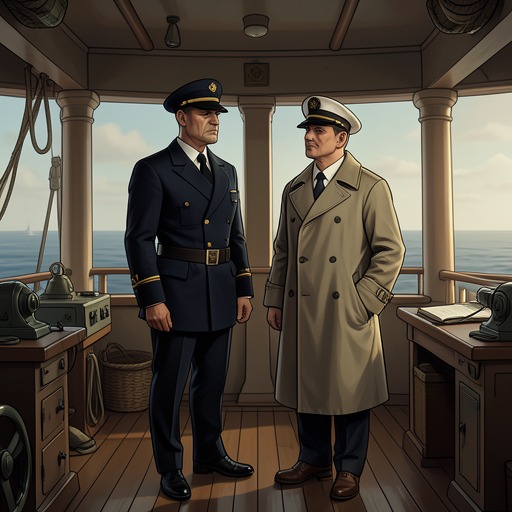
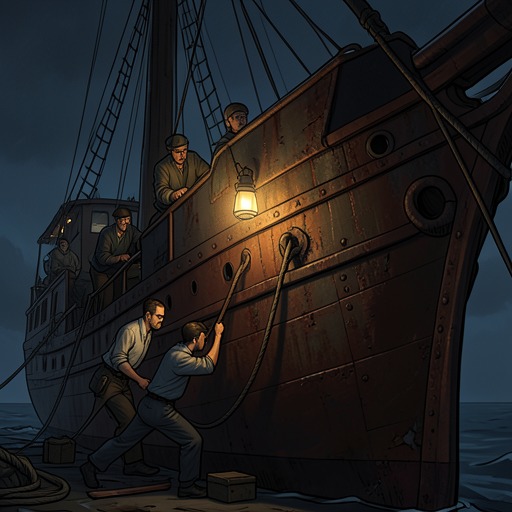
The method grew from the material conditions aboard USS Caine. When Captain de Vriess described the ship to Queeg, he emphasized its excessive rolling and pitching, failing power plant, obsolete machinery, crowded spaces, and hazardous working conditions in the firerooms. The men understood the risks, he said, but had learned how to manage their ship and had supported him in difficult situations. In his account, their rough appearance did not cancel out their effectiveness: they delivered when given room to work in their own way.
The ship’s daily routines show how such adaptation could be concrete rather than merely an attitude. During a watch, the forward fireroom requested permission to blow its tubes. Steve Maryk, serving as officer of the deck, checked the flag and granted the request; with the wind on the beam, soot would be carried clear. Maryk explained that a change of course might be needed to get the wind right, in which case the skipper’s permission would be required. The decision joined local knowledge of conditions to the chain of command instead of treating procedure as detached from the task.
Practical judgment and the book
Maryk defended the established way of operating by pointing to what USS Caine could and could not do. The ship got underway, reached its destinations, fired its guns effectively, and kept its machinery functioning, often through makeshift repairs. He argued that strict observance of the book could not be considered an uncomplicated improvement when, by that same standard, the ship seemed unfit to remain afloat. For him, procedure had to be interpreted in light of the vessel it governed.
Tom Keefer offered a sharper account of the opposing position. He saw the officers as civilians who resented being treated as incapable, but also recognized that wartime conditions gave the rule-bound officers’ expertise unusual authority. His comparison to a society suddenly organized around shining shoes cast naval bureaucracy as an absurd inversion of social status: people formerly dismissed as narrow specialists could now impose their standards on everyone. Yet Keefer also conceded that, while the war lasted, the book mattered. The analogy therefore exposes both the irritation caused by formal authority and the practical reason it could not simply be ignored.
Queeg’s new order
Queeg’s regime changed the crew’s behavior without displacing the older culture throughout the ship. After a cigarette butt was found in a scupper, he canceled liberty for the whole crew. The main deck was then kept swept, but once USS Caine sailed for Kwajalein, the general cleaning effort fell away except during inspections and in the small area near Queeg’s cabin, the bridge ladder, and the wardroom hatch.
The crew’s response took the form of what the narrative calls a circle of compliance. Sailors learned Queeg’s habits and kept his rules within the range of his attention; outside it, daily life remained much as before. When he noticed a new offense, his disapproval could become another shipboard rule, observed in that same limited area and disregarded elsewhere. This was not presented as a consciously planned conspiracy. It was a dispersed accommodation by individuals, alongside rough communal rules and respect for officers such as Maryk. Some sailors even regarded Queeg as a good captain provided they stayed out of his sight, while others who had clashed with him felt intense hostility.
The difference between formal order and actual practice also shaped the ship’s routine under prolonged pressure. Willie Keith’s early sleeping quarters were a cramped metal clipping shack, and later watches and clerical duties left him moving between the bridge, coding work, publication corrections, meals, and interrupted sleep. During the long escort assignments that followed, the days blurred into watches, logs, reports, audits, heat, rain, and repetitive voyages. These conditions help explain why an established, locally workable routine could matter as much as an official rule: the ship’s work was sustained not only by orders but by repeated adjustments made by the people living and working aboard it.
Reach and significance
The Caine way does not amount to a claim that rules are useless or that improvisation always succeeds. Its tension with Queeg’s system is sharper than that. USS Caine’s condition made strict formal standards appear poorly fitted to the vessel, while wartime service made coordination and regulations consequential. The novel places both needs aboard the same ship: the machinery and crew require flexibility, but a naval organization cannot operate on individual preference alone.
The ship’s later service underscores the distance between day-to-day work and the broad historical picture. While military histories could describe the war’s turning points as already decided by early 1944, Willie experienced it through exposed watches, operational orders, escort duty, and the strain of shipboard routine. Near the end of the war, USS Caine finally swept a mine in the China Sea. Later, after repairs to its pumps, it was still excluded from the planned sweep of Tokyo harbor because its condition and limited power made the voyage hazardous during typhoon season. Its practical adaptations had kept it useful, but they could not erase the limits imposed by its material state. The Caine way is therefore both a working resource and a measure of the gap between a ship’s formal assignment and what its worn equipment can safely deliver.